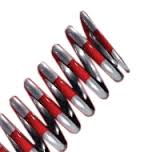
S-MH-O-1000-450 1" X 4-1/2" Md/hd Oval
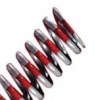
1" X 4-1/2" MD/HD OVAL DIE SPRINGS-LANSMHO1000450 >
Recently Viewed
1" X 4-1/2" MD/HD OVAL DIE SPRINGS-LANSMHO1000450 >
Browning® 1045343 VP Series Type 1 Variable Pitch Sheave, 1/2 in Finished Bore, 4.15 in OD, 1 Groove, 2.7 to 3.5 in (3L)/3 to 4 in (A/4L)/3.2 to 4.2 in (B/5L) Dia Pitch, 21/32 to 1-1/32 in W Face
The principle of a variable pitch sheave is that the threaded angular faced discs forming the V-shaped groove in which the belt rides are movable. VP sheaves consist of a male with a threaded barrel, and a female with a threaded bore. The male section with threaded barrel has flat surfaces at 180 deg increments that allow a flat surface for the setscrew to mate with. When the discs are moved toward each other, the belt rides higher in the groove and the pitch diameter of the sheave is larger which increases the driven speed. When the discs are moved away from each other, the belt rides lower and the pitch diameter is smaller decreasing the driven speed. The common term for this speed adjustment is called number of turns open from closed position.
GP® 8134MD Deep Length Socket, 6 Points, 3/4 in Drive, 8 Pieces, Included Socket Size: 26 to 38 mm, Molded Storage Case Container
BUCHANAN 2006S Splice Cap Crimp Connector, 18 to 10 AWG Solid Copper Wire, Non-Insulated Insulation, Copper
Crimp connectors from IDEAL® are designed for making fast, permanent, pressure-type connections. Whether there is a connection in a high vibration environment or installations at an OEM, there is a solution available. The steel and copper crimp connectors cover a wide range of combinations and have available insulating caps to protect against dangerous electrical shock.
V/H OUTPUT FLUORESCENT BULB-BULF96T12CWVHOALTO >
Synchronous belt drives help reduce the problems of slippage, belt stretch, lubrication and metal to metal contact. They provide superior performance because power is transmitted by positive engagement of belt teeth rather than by friction, as in conventional belt drives.