

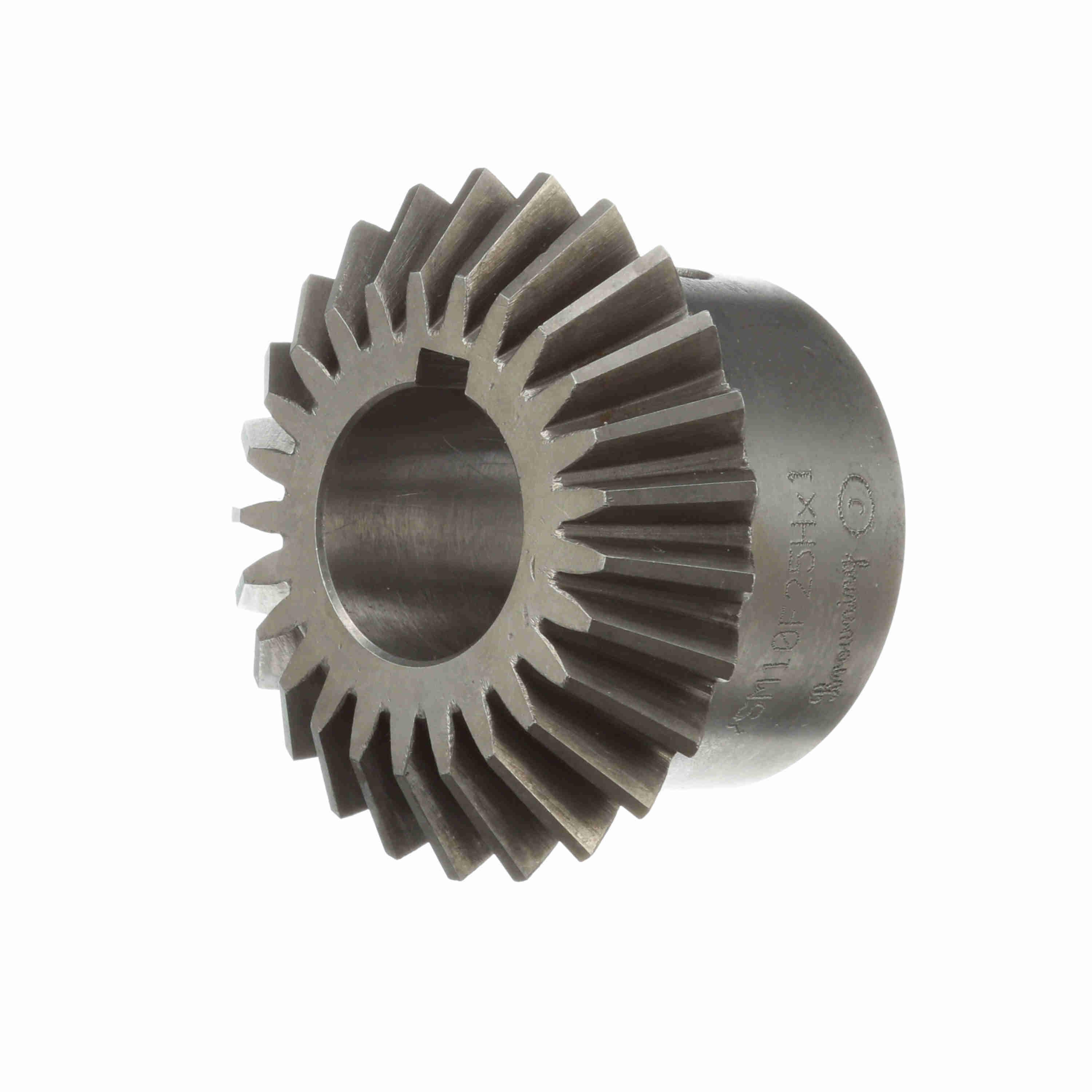
Browning® 1228865 Finished Bore Straight Miter Gear With Hardened Teeth, Keyway and Setscrew, 1 in Dia Bore

Bevel and miter gearing is a form of gearing in which the tooth-bearing surfaces are the faces of the gears rather than the edges. In bevel and miter gearing, the gears are cone shaped. This allows the edges of the mating gears to mesh and transmit torque. The geometry of the mesh creates a 90 deg angle. As a result, this type of gearing is suitable for applications where a change of direction is required. Other designs exist to create other angles however 90 deg serves the majority of applications. In bevel and miter gearing the input and output shaft are intersecting. It is typical for bevel and miter gear reducers to have lower reduction ratios. For example, 5:1 and lower are typical and they are different than other types of gearing. Two types of bevel and miter gearing are typical. These are straight and spiral. As the name implies, the teeth of straight bevel gears are cut straight. This means that the teeth are oriented perpendicular to the outside edge of the gear. The teeth on spiral bevel gears are cut at an angle to the outside edge of the gear. This type of gearing is said to have "helical" teeth and the angle is called the "helix" angle. Bevel and miter gearing have proven reliable for many years. The use of this type of gearing extends across many industries. Some of these include food processing, woodworking, paper and textile.
-
BrandBrowning®
-
UPC662289296422
-
Manufacturer Part Number1228865
-
CountryUSA
-
Face Width0.55 in
-
Pitch Diameter2-1/2 in
-
MaterialSteel
-
Pressure Angle20 deg
-
Gear Ratio1:1
-
TypeFinished Bore
-
Hub Diameter2 in
-
Hub Projection15/16 in
-
Diametral Pitch10
-
Number of Teeth25
-
Keyway Size1/4 x 1/8 in
-
Bore Diameter1 in
-
Overall Length1-5/8 in
- Miter Gears must be run in sets of two or more gears with the same pitch, Pressure angle and number of teeth
- Spiral Bevel and Miter Gears have continuous pitch line contact and are smoother and quieter than straight tooth gears
- Spiral Bevel and Miter gears must be run in sets of mating gears with opposite hand spiral
- Bevel and Miter Gears Develop Axial Thrust, Adequate Bearing support Must be Provided
-
Alternative Part NumberYSM10F25HX1
-
UNSPSC31171700
-
Package DescriptionEACH
-
Standards/ApprovalsAGMA Standard
-
Warranty1 Year
-
Catalog
Recently Viewed

Browning® 1228865 Finished Bore Straight Miter Gear With Hardened Teeth, Keyway and Setscrew, 1 in Dia Bore
Bevel and miter gearing is a form of gearing in which the tooth-bearing surfaces are the faces of the gears rather than the edges. In bevel and miter gearing, the gears are cone shaped. This allows the edges of the mating gears to mesh and transmit torque. The geometry of the mesh creates a 90 deg angle. As a result, this type of gearing is suitable for applications where a change of direction is required. Other designs exist to create other angles however 90 deg serves the majority of applications. In bevel and miter gearing the input and output shaft are intersecting. It is typical for bevel and miter gear reducers to have lower reduction ratios. For example, 5:1 and lower are typical and they are different than other types of gearing. Two types of bevel and miter gearing are typical. These are straight and spiral. As the name implies, the teeth of straight bevel gears are cut straight. This means that the teeth are oriented perpendicular to the outside edge of the gear. The teeth on spiral bevel gears are cut at an angle to the outside edge of the gear. This type of gearing is said to have "helical" teeth and the angle is called the "helix" angle. Bevel and miter gearing have proven reliable for many years. The use of this type of gearing extends across many industries. Some of these include food processing, woodworking, paper and textile.

SWIFFER WETJET PAD REFILLS--BX/12-PG-32698>
Dichtomatik N70326 O-Ring, 326 Dash Number, 1.6 in ID x 2.02 in OD, Nitrile Rubber, 70 Shore A Durometer, Import
O-rings are closed circular rings of circular cross-section. They are made through vulcanization from form tools as a complete ring. The sealing function of the O-ring is achieved by the deformation of the cross-section when installed and compressed in its housing. The O-ring can be compressed either radially or axially in its installation housing. In operating conditions the pressure exerted by the media reinforces the sealing function, as under pressure the elastomer material functions as a non-compressible fluid.
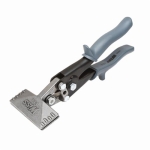
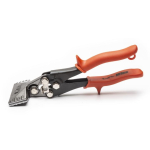
Crescent®WS6N Hand Seamer, 18 ga Metal Gauge, 6 in W x 1-1/4 in D, Graduations 1/4 in, Cushion Grip Handle
The Crescent Wiss® Straight Handle Hand Seamer is a powerful tool for bending or flattening sheet metal by hand. It utilizes an optimal handle span to deliver maximum power from an ergonomic operating range, and features non-slip cushion grips for superior comfort and control.
V-TYPE 2-5/16" BALL TRAILER COUPLER-HBC028463 >

ISOSTATIC™ Oilube® 202427 Round Bore Thrust Washer, 2 in ID x 3 in OD, 1/8 in THK, 10 to 175 deg F, SAE 841 Powdered Metal/Oil Impregnated Bronze

