

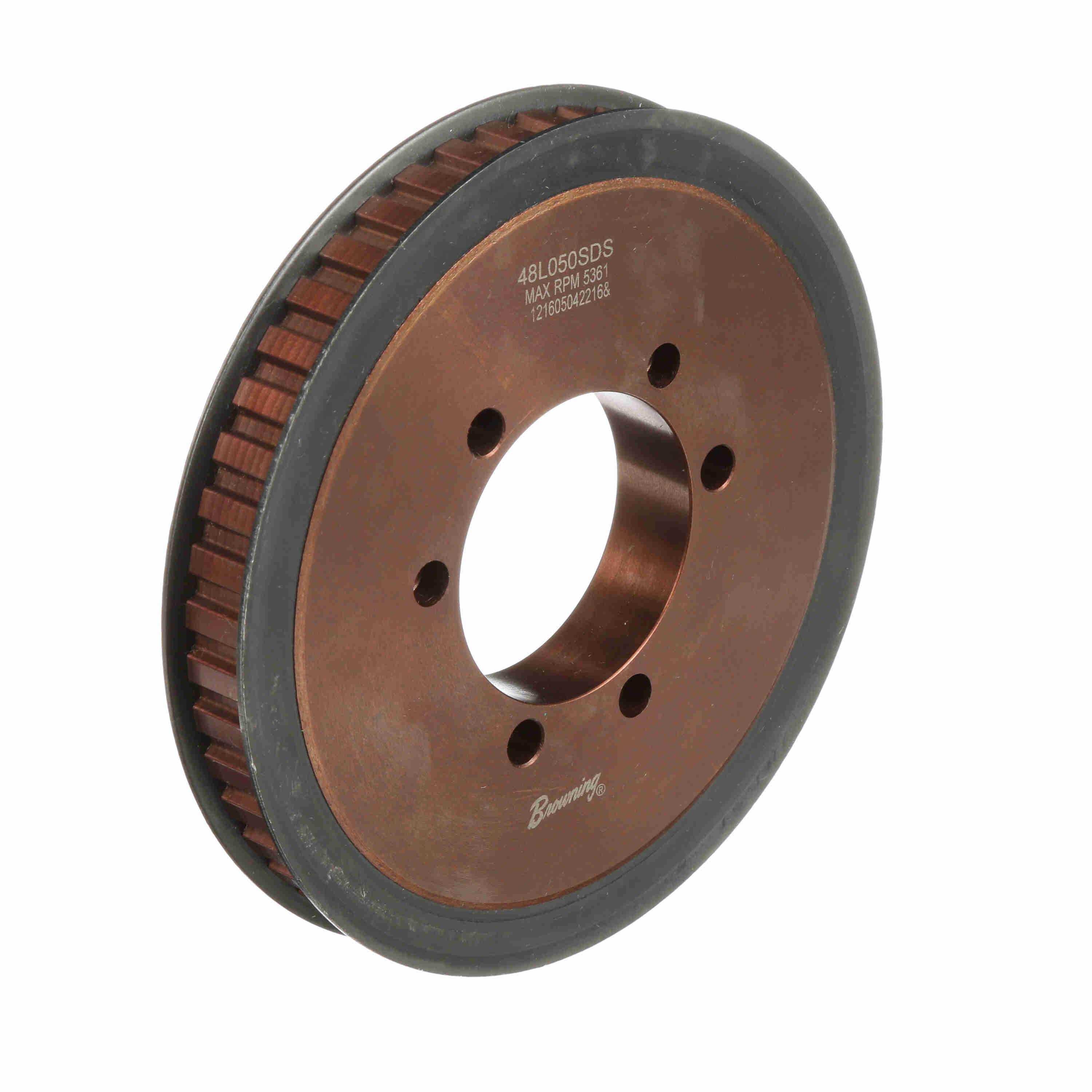
Browning® Gearbelt® 3513108 Solid Type BF Synchronous Timing Pulley With Flange, 1/2 to 2 in QD® Bore, 5.222 in OD, 44 Grooves, 5.252 in Dia Pitch, 3/4 in W Face

Synchronous belt drives help reduce the problems of slippage, belt stretch, lubrication and metal to metal contact. They provide superior performance because power is transmitted by positive engagement of belt teeth rather than by friction, as in conventional belt drives.
-
BrandBrowning®
-
UPC662289352258
-
Manufacturer Part Number3513108
-
CountryUSA
-
Face Width3/4 in
-
Bushing TypeSDS
-
Pitch3/8 in
-
Pitch Diameter5.252 in
-
Flange Diameter5-31/64 in
-
TypeSolid Type BF
-
Number of Grooves44
-
Outside Diameter5.222 in
-
Bore Diameter1/2 to 2 in
-
Bore TypeQD®
-
Overall Length1.48125 in
-
Suitable For Use With1/2 in W L050 Type Belt
- Constant speed, no slip, no creep, minimum backlash, because of the positive grip of the belt teeth with pulley grooves
- High modulus strength member, needs minimum take-up
- Freedom from initial belt tension, reduces bearing loads, increases life
- Compact design Gearbelt® belts permit smaller pulleys, shorter centers and narrow belts
- Lightweight, high horsepower-to-weight ratio makes Gearbelt® drives ideal for any application where weight is an important factor
- Less heat, because Gearbelt® drives generate virtually no friction
- No lubrication required
- Wide load capacity range
- Wide belt speed range
-
Alternative Part Number44L050SDS
-
UNSPSC26111807
-
Package Description1/PK
-
Warranty1 Year
-
Catalog
-
Instruction/Installation Manual
-
Specification Sheet
Recently Viewed

Browning® Gearbelt® 3513108 Solid Type BF Synchronous Timing Pulley With Flange, 1/2 to 2 in QD® Bore, 5.222 in OD, 44 Grooves, 5.252 in Dia Pitch, 3/4 in W Face
Synchronous belt drives help reduce the problems of slippage, belt stretch, lubrication and metal to metal contact. They provide superior performance because power is transmitted by positive engagement of belt teeth rather than by friction, as in conventional belt drives.

TAPERED ROLLER BEARING CUP-NTNLM806610 >
TAPERED ROLLER BEARING CONE - NTNH414249>
45 DEGREE STREET ELBOW FOR CONNECTING A MALE-ENDED ND FEMALE-ENDED PIPE AT AN ANGLE, MALE NPT THREADS ON ONE END AND FEMALE NPT THREADS ON THE OTHER FOR CONNECTING PIPES WITH DIFFERENT ENDS. PRECISION MOLDED IN STERILIZABLE POLYPROPYLENE FOR DIMENSIONAL STABILITY AND REINFORCED WITH FIBERGLASS FOR ADDED DURABILITY, STRENGTH, AND CHEMICAL RESISTANCE. HANDLES PRESSURE UP TO 300 PSI. SCHEDULE 80 POLYPROPYLENE FOR A THICKER WALL THAN SCHEDULE 40
-BAJSL10045 >
SWEAT SOLDER. COPPER TO FEMALE PIPE THREAD;3/4" NOMINAL COPPER TO 3/4" FIPS-JWH418426 >

Browning® 1059427 Type F Multiple Sheave, 0.88 to 0.875 in Finished Bore, 2.65 in OD, 2 Grooves, 2.6 in Dia Pitch, 1-3/32 in W Face
Browning® offers an extensive multi-groove sheave offering. This includes Browning® Split-Taper® and QD® bushing designs. This means maximum economy and versatility for your application. Truly the right drive every time our exclusive B5V® sheaves have a patented design that offers 5V horsepower in the economy of a B section sheave. B5V® sheaves serve 90% of all applications from 10 to 150 hp. This can reduce cost up to 40% over traditional designs.

